
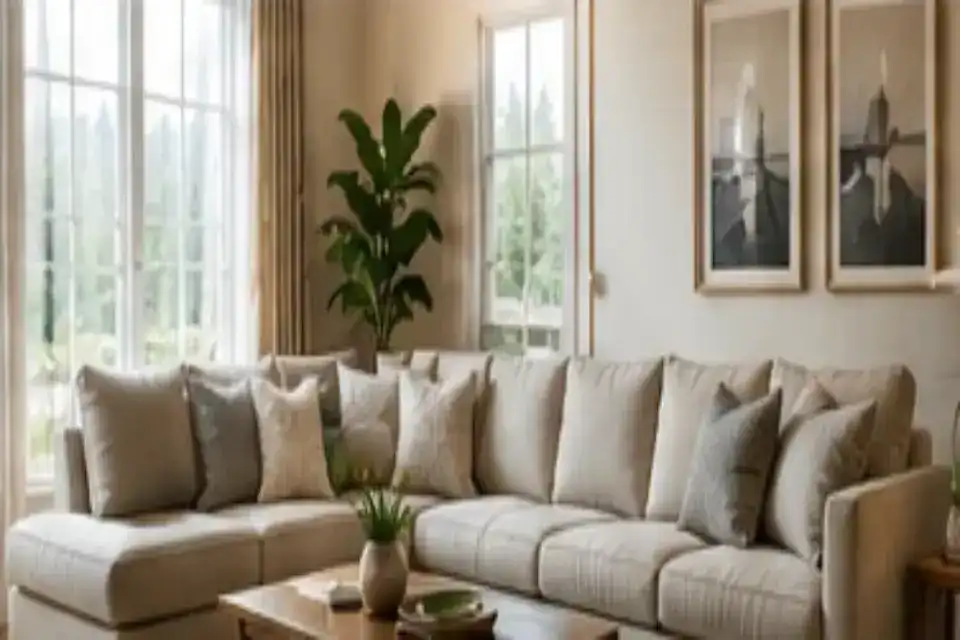
Walk into a room that was decorated a decade ago and you can usually guess the year. Walk into a room built on good principles instead of a trend, and you often can't — it simply looks like someone's home. That's the real goal of interior design: not chasing what's current, but building a space that holds up because the choices underneath it were sound to begin with. Here are the ten principles that quietly do the most work in a home that feels considered rather than decorated.

1. Let architecture set the rules, not fight it
Before choosing a single fabric or paint color, look at what the room is already telling you. Ceiling height, window placement, natural light, and traffic flow are fixed; furniture and finishes are not. A low-ceilinged room wants horizontal lines and light tones to keep it from feeling squeezed. A room with one dramatic window wants furniture arranged to face it, not away from it. Fighting a room's bones costs more, in money and in daily friction, than working with them.
Practical checkpoint
Before moving on, make sure 1. Let architecture set the rules, not fight it is working for the space described in this guide.
2. Scale before style
A beautiful sofa in the wrong size will bother you every day in a way you can't quite name. Before shopping for style, measure. Walkways should generally allow 30 to 36 inches of clearance. A rug should be large enough that at least the front legs of major furniture sit on it — a too-small rug is one of the most common reasons a well-furnished room still feels unsettled. Scale is invisible when it's right and impossible to ignore when it's wrong.
3. One material family, several textures
Rooms that feel expensive rarely have more colors than a beginner's room — they usually have fewer, paired with more texture. Pick a warm or a cool base (oak versus walnut, brass versus nickel) and stay loyal to it across a room. Then vary texture instead of hue: a boucle chair, a linen curtain, a jute rug, a lacquered side table. Texture is what keeps a restrained palette from reading as boring.
A room doesn't need more colors. It needs more reasons for the eye to want to stay in it.
4. Layer three kinds of light
A single ceiling fixture is the fastest way to make a nice room look like a hotel conference space. Aim for three light layers in every main room: ambient (general illumination), task (reading lamps, under-cabinet lights), and accent (a picture light, a candle, an uplight behind a plant). Put table and floor lamps on the same dimmer circuit where possible, and favor warm-white bulbs (2700–3000K) in living spaces — it's the single cheapest upgrade that changes how a whole room feels in the evening.
5. Hang art and mirrors at eye level, not ceiling level
The standard museum guideline is to center artwork about 57 to 60 inches from the floor to its middle point, adjusted down slightly above furniture like a sofa or console. Most people hang art too high because they're anchoring to the frame's top edge instead of its center — an easy habit to break once you know to look for it.
6. Buy fewer, better anchor pieces
A room built entirely from budget pieces bought at once tends to feel flat, because everything arrived with the same intent and the same era's aesthetic. A room built around one or two pieces that matter — a solid wood dining table, a well-made sofa, an inherited chair — has somewhere for the eye to rest, and the cheaper, faster pieces around it read as intentional supporting cast rather than the whole cast.
7. Negative space is a design decision
Empty wall, uncluttered floor, and a shelf that isn't full are not gaps to be filled — they're part of the composition, the same way rests matter in music. A room where every surface holds something reads as anxious. Leave visible breathing room around at least one wall, one shelf, and one tabletop in every space.
8. Repeat one element at least three times
Designers call this the 'rule of three,' and it's really about rhythm: a black metal finish that shows up on a light fixture, a picture frame, and a table base ties a room together without anyone consciously noticing why it feels cohesive. Pick one finish, one shape, or one color to repeat deliberately through a space.
9. Curtains should nearly touch the ceiling and puddle at the floor
Mounting curtain rods 4 to 6 inches below the ceiling (rather than just above the window frame) makes ceilings read taller and windows read larger — one of the highest-impact, lowest-cost changes in a room. Curtains should break at the floor or just graze it; stopping several inches short is the visual equivalent of pants that are too short.
Quick gut-check
Stand in a doorway and look at the room as a whole before judging any single piece. Most 'something feels off' problems are actually scale or light problems, not color problems.
10. Design for how you actually live, not how the photo will look
The most timeless rooms are the ones built around real habits: where you actually read, where the dog actually sleeps, where mail actually piles up. A home edited entirely for photographs stops working the day you move a throw pillow. Give real routines a real place, and the room will keep making sense long after any particular trend has moved on.
None of these ten ideas require a large budget. What they require is sequencing — light and scale before paint color, structure before decoration. Get the order right, and a room built this year can still feel entirely at home a decade from now.
Frequently asked questions
Where should I actually start if I'm redecorating one room?
Start with lighting and furniture scale, not paint. Most people reach for a paint color first because it feels like the biggest visible decision, but color choices are far easier to get right once the room's proportions and light layers are already working. Fix the bones first, then choose finishes.
How do I know if my furniture is actually the wrong scale?
Stand at the room's main entry point and look at the negative space around each piece. If a sofa or table seems to be straining against the walls, or if there's an awkward no-man's-land of empty floor that nothing quite reaches, scale is usually the culprit rather than style. Measuring before buying, and taping out a piece's footprint on the floor with painter's tape, catches most scale mistakes before they become expensive ones.
Is it really worth repeating a finish three times in a room?
It sounds like a small detail, but it's one of the most reliable ways to make a room feel professionally put-together rather than assembled piece by piece. The repetition doesn't need to be obvious — a black hardware finish on a light fixture, a picture frame, and a table leg is often enough for the eye to register the room as cohesive without consciously noticing why.